Ontological Shock: Part 2 — The Model Was Never Big Enough
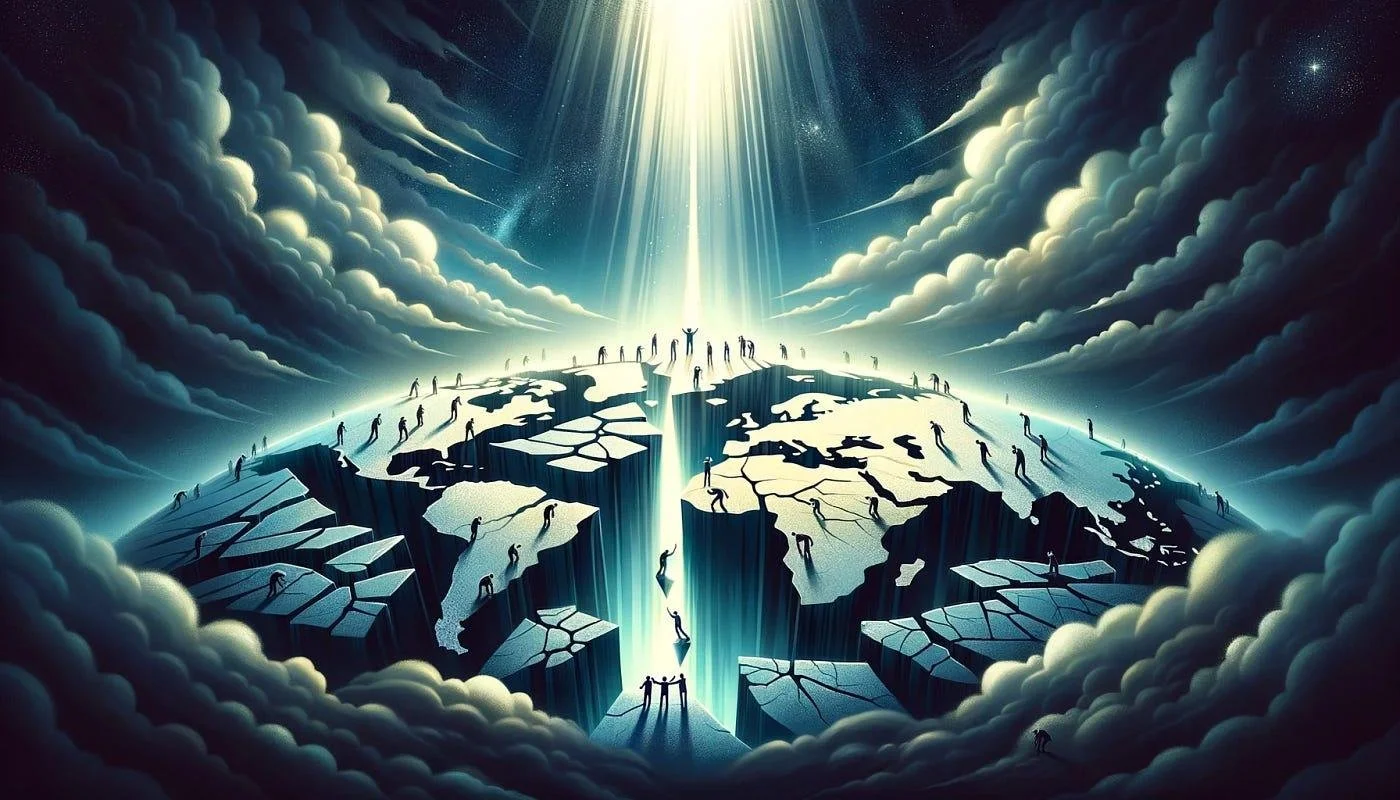
The first part was about the fracture. This part is about what happens when that fracture doesn’t stay contained. It spreads, and it heads straight for the places people protect the hardest. Not surface-level opinions or shit people argue about for fun. I’m talking about the foundations. God. History. Work. Government. Reality itself. The structures people lean on so they don’t have to constantly question what’s underneath them.
Now you’ve got pressure building in a way we haven’t seen before. Trump is openly talking about releasing UFO files, directing the Department of War to declassify what it has. Take a moment and strip away the political noise and just look at the implication. The same system that spent decades dismissing, ridiculing, and burying this topic is now being pushed toward disclosure. That’s not a minor shift. That’s a signal that something is changing behind the curtain. And once that curtain opens far enough, people are going to realize their understanding of reality wasn’t just incomplete.
It was fucking managed.
This is no longer interesting; it’s now become personal.
Because real disclosure doesn’t just mean “aliens exist.” That’s the surface-level version people cling to so they don’t have to think any deeper. Real disclosure forces questions people have spent their entire lives avoiding.
What are these intelligences?
How long have they been here?
What do they know about us?
What has been known about them?
What does that mean for everything we thought we understood about existence?
That’s not a small adjustment people. That’s a full goddamn rewrite, whether anyone likes it or not.
Let’s begin with spirituality, because this is where people are going to feel it immediately whether they admit it or not. Most traditional systems operate inside a very tight framework. Angels on one side, demons on the other. Good versus evil. Everything categorized and labeled so it can be understood quickly and safely. It gives people a way to deal with the unknown without actually expanding into it.
Now introduce nonhuman intelligence into that structure and watch what happens. People don’t explore it. They’ll refuse to. Instead, they categorize it. Fast. Automatic. Defensive. They call it demons. They call it fallen angels. They call it deception. And I understand why they do it, (although it aggravates me to no end) it protects the framework. It lets them encounter something new without actually changing a damn thing as it pertains to their worldview.
But here’s the problem. That response doesn’t come from clarity. It comes from conditioning.
If you actually slow down and ask the question, it starts to fall apart. What exactly is an angel in that framework? Nonhuman, intelligent, operating outside normal physical limits, capable of interacting with humanity, carrying knowledge beyond ours. That’s the definition people are working with whether they realize it or not. So if something shows up that fits those characteristics, why the hell is the default label “demon”? Why is the unknown automatically negative? Why is the framework only allowed to expand in one direction, and it’s always toward fear? Someone please make it make fucking sense.
At some point, you have to admit that the system wasn’t built to understand the unknown. It was built to contain it.
That doesn’t make faith wrong. It means the interpretation might be too fucking small. And if your understanding of the universe can’t expand when reality itself expands, then you’re not protecting truth. You’re protecting comfort.
Now take that same pressure and apply it to history. This is where things really start to get uncomfortable. People love the idea that human civilization is mostly figured out. A clean progression from primitive to advanced, with a few mysteries sprinkled in for curiosity. Some people still hold to a very short timeline, others trust the mainstream version more loosely, but both positions assume the general story is solid.
It isn’t.
The evidence doesn’t support that level of confidence, and it hasn’t for a long time. Göbekli Tepe alone should have forced a much more aggressive rewrite of the timeline. Massive, organized construction over 11,000 years ago, long before civilization was supposed to exist in that form. That doesn’t just tweak the timeline. It breaks the assumption that we understand where civilization started.
But instead of blowing the model open, it gets absorbed. Adjusted. Contained. Silenced. That’s what institutions do. They don’t like rewriting themselves unless they absolutely fucking have to.
You see the same thing with sites like Puma Punku, where the precision of the stonework raises serious questions about the tools and methods that were supposedly available. Or Baalbek, where the sheer size of the stones forces you to question how they were moved at all. Or the Antikythera mechanism, which shows a level of mechanical complexity that doesn’t fit neatly into its time period. Or the repeated patterns across ancient cultures describing advanced knowledge, sky beings, and interactions that sound a lot less like imagination when you stop dismissing them automatically.
Individually, each of these can be explained away. Together, they start forming a pattern that doesn’t fit the narrative we were given.
And this is where people need to be honest with themselves. Academia is not some perfectly objective machine that updates itself instantly when new information appears. It’s a human system. It protects its models. Careers, funding, and credibility are tied to those models. When something doesn’t fit, it often gets pushed to the side, reframed, or labeled fringe so people don’t have to deal with it.
Fringe is a really convenient word. It basically means “don’t look too closely because this might mess with your worldview.”
Ancient texts like the Bible describe repeated interactions between humans and non-human intelligences. If we take those accounts seriously, it’s not unreasonable to consider that advanced civilizations, whether technological or otherwise, may have existed long before our own and influenced early human history.
Now introduce the possibility of nonhuman intelligence interacting with humanity across time and everything shifts. Those anomalies stop looking random. They start looking like pieces of something bigger. And if even part of that is true, then the timeline we’ve been operating under isn’t just slightly off.
It’s incomplete as hell.
Now bring it into daily life, because this is where it stops being theoretical. If disclosure leads to the acknowledgment of advanced technologies, everything changes. Energy, transportation, medicine, communication. Entire industries start to look outdated. Not improved. Outdated.
And that leads to a question that’s going to hit people hard.
Why the fuck were we still living like this?
Why are people working their entire lives just to survive inside systems built on scarcity if better options exist? That’s not philosophical. That’s personal. Because people don’t just work for money. They build their identity around it. Their sense of purpose. Their sense of stability.
So when that structure gets challenged, it’s not just economic disruption. It’s psychological. Who are you if the system you built your life around doesn’t make sense anymore?
That’s ontological shock hitting daily life.
Now let’s look at governments. If disclosure confirms that information (and technology) has been withheld at this level, trust doesn’t just weaken. It shatters. People aren’t just going to ask what was hidden. They’re going to ask why it was hidden. Who decided humanity couldn’t handle the truth? Who decided what people were allowed to know about their own reality? (This is a rabbit hole I’d love to take you down, let us know!)
That’s not a small crack. That’s a serious legitimacy problem.
Because once people realize that truth may have been filtered or controlled, every other piece of information coming from those same systems becomes questionable. Authority doesn’t disappear overnight, but it sure as hell doesn’t carry the same weight either.
And then you get to the core of it. Reality itself.
Because if nonhuman intelligence exists, if consciousness plays a role in interaction, if history is incomplete, if technology operates beyond what we understand, then reality is not what we thought it was.
Not even close.
And that realization is where everything comes together. The old model says you’re a biological machine in a mostly dead universe, reacting to a fixed environment. A larger model suggests something very different. That consciousness may be fundamental. That reality may be more interactive than passive. That intelligence may exist across layers we don’t yet understand.
That’s not just new information. That’s a completely new playing field.
And this is where awakening actually becomes real. Not the soft, feel-good version people throw around. The real version. Awakening is realizing the model you were using doesn’t hold anymore. It’s not comfortable. It’s not peaceful. It’s watching your understanding break and having to rebuild it without the safety net you had before.
That’s ontological shock sustained over time.
And that’s where we are.
Not waiting for it.
In it.
UAP disclosure, exposure of power structures, and the resurfacing of ancient knowledge aren’t random events. They’re pressure points. And they’re converging. Some people are going to resist it. Some are going to ignore it. Some are going to dive into it without grounding and lose themselves.
And some are going to do the harder thing. They’re going to sit with it. They’re going to question. They’re going to rebuild their understanding instead of forcing reality to fit what they were told.
Because at a certain point, the breaks become impossible to explain away. When your politics, your faith, your history, your science, and your entire sense of what’s real all start cracking at the same time, it’s not a coincidence. It’s not “the world going crazy.”
It’s the old map burning in your hands while the actual territory stands there staring you in the face.
The model was never the full picture. It was just the comfortable lie we all agreed to live inside.
And reality?
Reality is done playing along with our bullshit.