Ontological Shock: Part 1 — The Ground You Trust Is Already Breaking
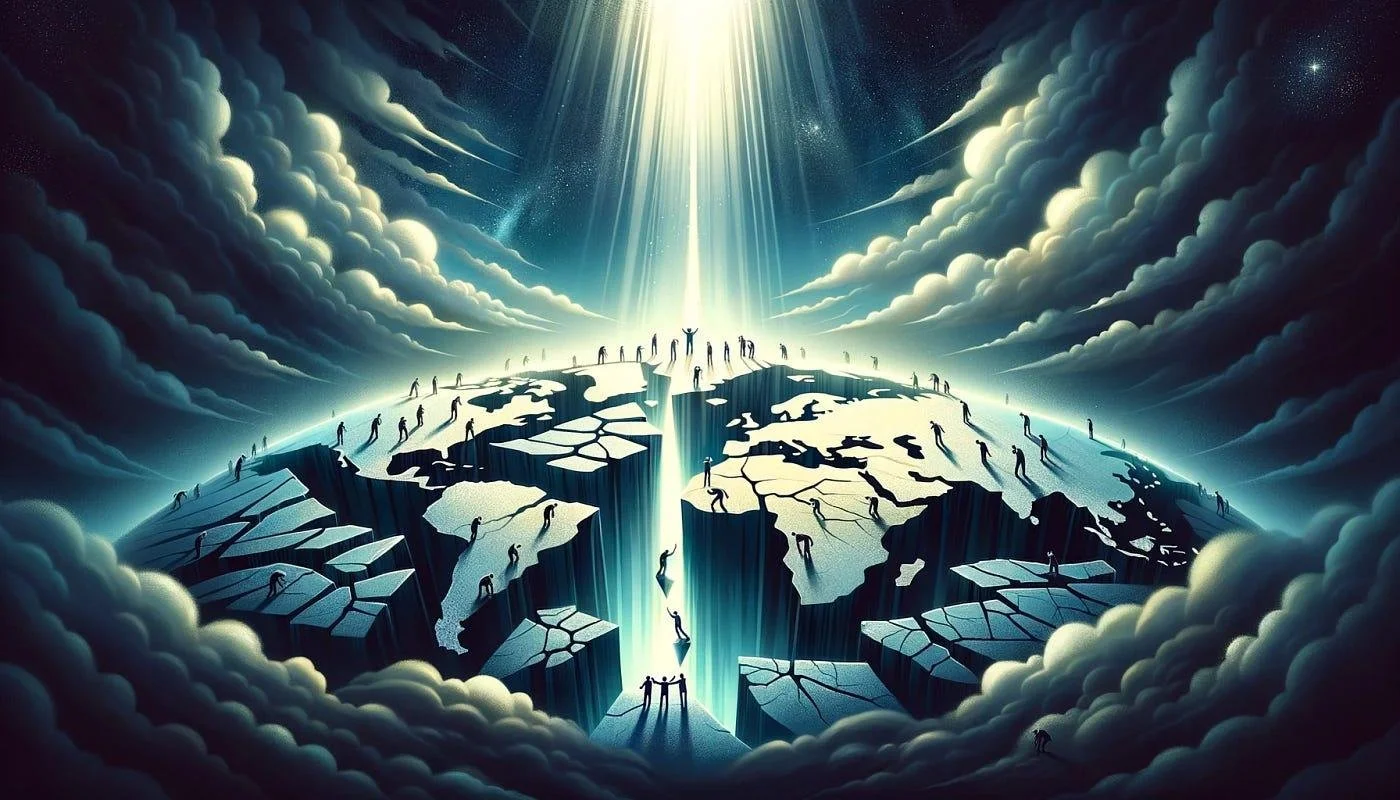
The room feels steady beneath your feet. The coffee in your mug tastes the same as yesterday. Your phone lights up with the same noise it always does. Bills, headlines, someone complaining about traffic like it’s the end of the world. Everything is normal in the way normal has always been. Predictable enough that you don’t question it. Familiar enough that you don’t need to. That’s the quiet agreement most people live inside. Not spoken or written, just understood. Reality is stable. The world works the way we were told it works. You wake up, you move through it, and you don’t have to constantly re-evaluate the foundation you’re standing on.
Until something shifts.
It doesn’t come crashing in with sirens or spectacle. It doesn’t announce itself like some cinematic moment. It slips in quietly. One piece of information that shouldn’t exist but does. One moment where the narrative doesn’t quite line up. One calm admission from someone in authority that feels far too casual for what it implies. And something inside you tightens. Not panic or fear. Something deeper. The realization that the ground you’ve been standing on might not be as solid as you thought.
That feeling has a name. Ontological shock.
Most people won’t understand what that means until it hits them directly. It isn’t surprise. It isn’t confusion. It isn’t even disbelief. It’s what happens when the framework you use to understand reality itself begins to fracture. Not your opinions. Not your preferences. Your reality. The invisible structure that tells you what exists, what doesn’t, what’s possible, what’s not, and where you fit inside all of it. Ontology is the study of being, of existence itself. Every person carries an internal version of that whether they realize it or not. It’s the operating system running your life in the background. Built slowly through education, culture, religion, authority, repetition. You inherit it before you ever question it, and over time it becomes so embedded that you mistake it for reality itself rather than recognizing it as a model of reality.
Ontological shock is what happens when that model breaks.
Not bends.
Not stretches.
Breaks.
Theologian Paul Tillich described it as a confrontation with non-being, an encounter with something so far outside your understanding that it destabilizes your sense of existence itself. Harvard psychiatrist John Mack saw this clearly in people who reported encounters with non-human intelligence. Their experiences did not just challenge their beliefs. They shattered the boundary between what was possible and what was impossible. Their identity, their worldview, their sense of meaning all had to reorganize around something that did not fit into their previous understanding. That’s why this hits as hard as it does, because your identity is built on your understanding of reality. Who you are, what you believe, how you move through the world, all of it is anchored to what you think is true. When that anchor loosens, even slightly, you feel it everywhere.
For a long time, this kind of shock was rare enough to ignore. It lived on the fringes. People who experienced it were labeled, categorized, pushed out of the conversation so the larger structure could remain intact. But that containment is failing, and it’s not failing because of one dramatic revelation. It’s failing because multiple threads are converging at the same time, pressing against the same fragile framework people have been relying on without realizing it.
Start with the one that used to be the easiest thing in the world to dismiss. UFOs. For decades, the topic was shut down with almost reflexive certainty. Weather balloons, swamp gas, misidentifications, fringe nonsense. That narrative held because it was reinforced from every direction that mattered. Authority dismissed it. Media mocked it. Education ignored it. It became safe to laugh at because you were told it wasn’t real.
That doesn’t hold anymore.
You now have verified military footage showing objects moving in ways that do not align with known physics. You have trained pilots describing encounters they cannot explain. You have congressional hearings where credible individuals testify under oath about programs involving non-human craft and materials. And now you have something far more significant than all of that combined, a sitting administration directing the Department of War to begin declassifying the files it has on this subject.
That’s right. Declassifying files on a subject they have forever claimed doesn’t exist.
Yet they have files on it.
….Take all the time you need.
That is not a subtle shift. That is a fracture point.
Because if even a fraction of what has been suggested is confirmed, humanity is forced to confront something it has never had to face collectively, not as a theory or belief but as reality. That we are not alone. That we may never have been. That there are intelligences and technologies operating alongside us that we do not understand. You don’t just absorb that and continue on as if nothing changed. It reshapes how you see yourself, your place in existence, your understanding of history, your interpretation of science, your relationship to religion. It dismantles the quiet assumption that we are the center of anything. That is ontological shock in its purest form, and from a deeper perspective it does not just challenge reality, it expands it. Because if non-human intelligence exists and has interacted with humanity, then consciousness itself becomes a much larger conversation. The idea that awareness is not limited to the human brain starts to feel less abstract. The possibility that reality is layered, interconnected, and alive in ways we have not been taught begins to move from speculation into something much more real.
Now place another layer on top of that. The exposure of power. The Epstein case did not just reveal criminal behavior. It revealed structure. A network of influence, protection, and silence that extended far beyond what most people were comfortable considering. And as more documents and associations continue to surface, people are being forced to confront something deeper than outrage. They are being forced to confront the possibility that systems they trusted to operate with some level of integrity may not function the way they thought they did. That power moves in layers. That information itself can be controlled, filtered, withheld. And when that realization begins to overlap with something as destabilizing as UAP disclosure, the effect compounds. Because now it is not just about what exists beyond our understanding. It is about what has been kept from our understanding.
That question does not stay contained once it appears. It spreads. What else has been filtered. What else has been shaped. What else has been presented in a way that maintains stability rather than reflects truth. That is where ontological shock deepens, because it is no longer about one revelation. It becomes about the reliability of the framework itself.
Now take it one layer deeper. Ancient knowledge. For a long time, ancient texts, myths, and religious accounts were treated as symbolic or fictional. Stories meant to convey meaning, not records of anything real. But when you begin placing those accounts next to modern anomalies, something begins to shift. Descriptions of flying craft. Encounters with beings from the sky. Knowledge appearing in places and times where it should not exist according to the timeline we were taught. Patterns across civilizations that had no contact, yet describe similar phenomena. Individually, each of these can be dismissed. Together, they create pressure. Not proof, but pressure. Enough to make you question whether the story we have been given about humanity is complete.
From a spiritual perspective, this is where things begin to open in a way most people are not prepared for, because if those accounts are not purely symbolic, if they are fragments of real interaction or real knowledge that has been filtered over time, then humanity’s relationship to existence is not what we thought it was. It is older, deeper, more interconnected. The idea of awakening, of expanding consciousness beyond the limited identity of the individual, begins to feel less like abstract spirituality and more like something grounded in reality itself. Awakening is not escaping reality. It is seeing it clearly, and that process is not peaceful in the way people like to pretend it is. It is destabilizing, because awakening is sustained ontological shock. It is the gradual realization that what you thought was real was only a fraction of what is.
That is where we are now. Not at the end of something, but at the beginning of a convergence. UAP disclosure, exposure of power structures, and the re-emergence of ancient knowledge are not isolated events. They are pressure points. And pressure creates change. Some people will resist it. Some will ignore it. Some will dive into it without grounding and lose themselves in it. And some will do something much harder. They will sit with it. They will question carefully. They will rebuild their understanding piece by piece instead of clinging to what no longer holds or throwing everything away.
Because ontological shock is not just destruction. It is initiation. It is the tearing down of a limited framework so something more expansive can take its place. And whether people realize it or not, this is not something we are waiting for. It is already happening. Quietly. Consistently. In fragments. And it is going to intensify. More disclosure. More exposure. More pressure on the current understanding of reality. Not all at once, but enough to make it impossible to pretend everything is exactly the way we thought it was.
This is part one because what comes next matters more than what has already been revealed. Because once the structure cracks, once the illusion of certainty begins to fall apart, the real question is not what was hidden.
The real question is whether you are capable of seeing what is being shown without needing it to fit the world you were told to believe in.