The Inverted Bible Theory
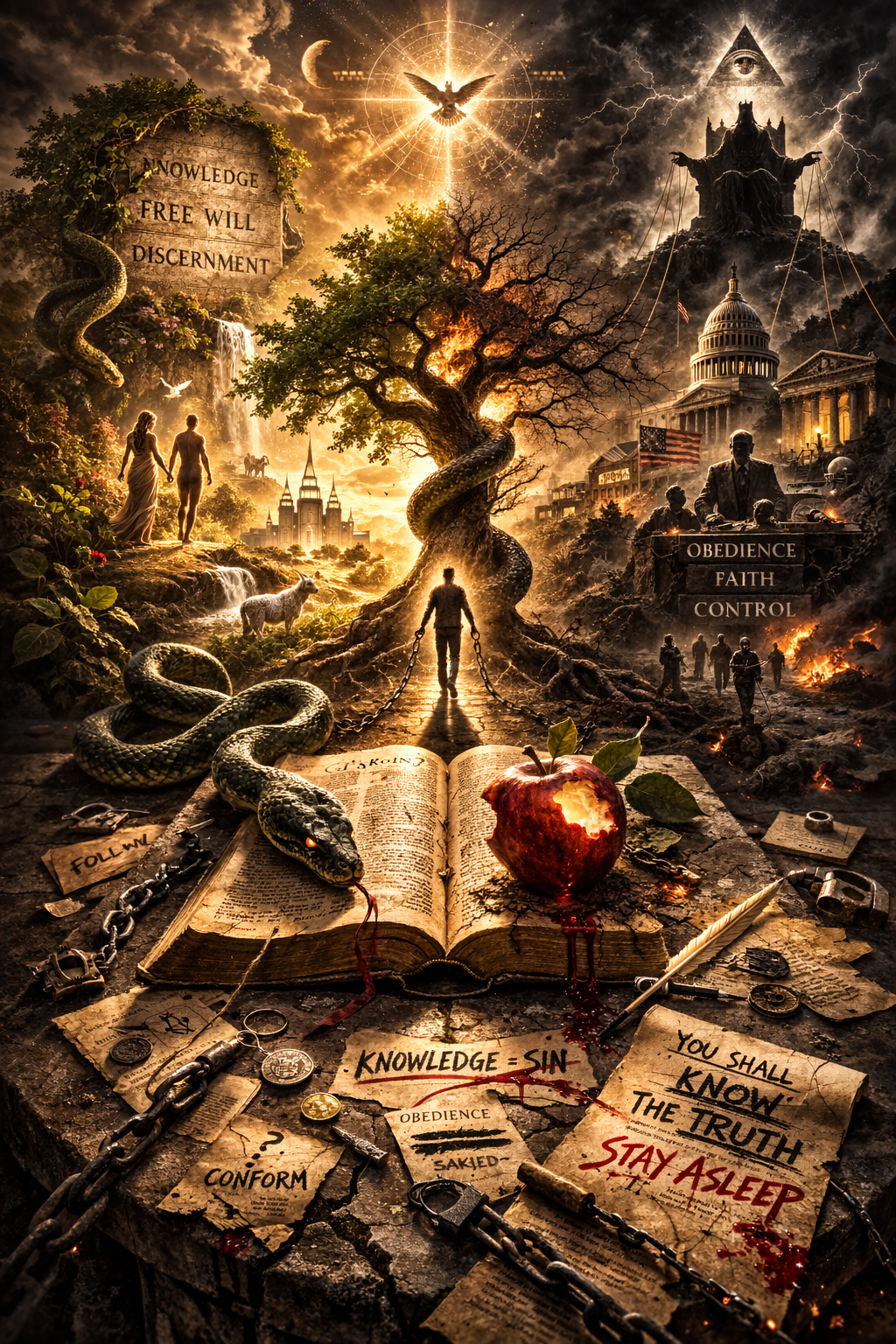
There is a story almost all of us inherited before we had the cognitive tools to examine it. It was handed to us with reverence, with stained glass and Sunday voices, with the quiet understanding that this is how it began and therefore this is how it must be understood. A garden planted by God. A tree placed at its center. A command delivered without explanation. A serpent who questions. A fall that fractures the world.
We were told this story explains suffering. It explains death. It explains why humanity struggles and sweats and buries its dead. It explains shame. It explains evil. It explains everything.
But what if it explains something else entirely?
What if it is not the beginning of sin but the beginning of awareness?
If you slow down and look at the Genesis narrative without inherited interpretation rushing in to fill the gaps, something curious appears. Humanity is placed inside a closed system. It is abundant, yes, but it is structured. Boundaried. Ordered. There is one prohibition: do not eat from the tree of the knowledge of good and evil. Everything else is permitted.
Notice what is forbidden. Not violence. Not oppression. Not exploitation. Not harm. Knowledge. Moral discernment. The ability to distinguish good from evil independently.
That is the boundary.
You may exist here. You may thrive here. You may enjoy provision. But you may not know.
The command is informational. It is epistemological. It is about consciousness.
And when the serpent appears, he does not force, threaten, or dominate.
He asks a question: “Did God really say…?”
That question destabilizes authority not through rebellion but through inquiry. The first recorded act of defiance in scripture is not murder, not theft, not violence. It is the act of questioning what was said.
That detail alone should be unsettling.
The serpent’s claim is simple. “You will not surely die. For God knows that when you eat from it your eyes will be opened, and you will be like God, knowing good and evil.” The promise is not destruction. It is awakening. Awareness. Elevation.
When they eat, they do not drop dead. The text does not say they collapse. It says their eyes are opened. They see themselves differently. They perceive nakedness. They become self aware. They recognize distinction.
Something changes.
And then comes exile.
The punishment is removal from the system. Removal from the garden. Removal from proximity to the tree of life.
If you remove the inherited moral framing and look at the structure psychologically, it resembles development. A child lives under authority in a contained environment. A boundary is crossed. Awareness dawns. Innocence dissolves. Separation occurs. Growth requires departure.
The myth, at minimum, encodes the transition from unconscious existence to self awareness.
Now ask something more uncomfortable.
Why is knowledge framed as disobedience?
Why is awareness followed by punishment?
Why is the act of becoming “like God” — through knowledge — treated as threat?
If you wanted to maintain a hierarchy, you would not fear blind obedience. You would fear independent discernment. If individuals can define good and evil internally, they become harder to govern externally. If morality is internalized, authority becomes negotiable.
Faith becomes the stabilizer.
Across history, the highest virtue in hierarchical systems is not curiosity. It is obedience. It is trust. It is submission to authority even when understanding is incomplete.
You do not need to assume malice to observe this pattern. It is structural.
Now widen the lens beyond Genesis.
The Tower of Babel presents another strange moment. Humanity unites with one language and begins building upward. God observes and says that if they continue, nothing they plan to do will be impossible for them. The response is confusion of language and dispersal.
Notice the reasoning. The concern is capacity. Unity plus shared understanding produces limitless potential.
The intervention fragments that unity.
Again, knowledge and coordination appear to trigger containment.
Consider Sinai. The law descends from above in thunder and smoke. Authority externalized. Command centralized. The people tremble and request mediation rather than direct exposure to divine presence.
The pattern holds.
Authority above. Obedience below.
Yet scripture itself contains tension within this hierarchy. Jesus says, “The kingdom of God is within you.” That is not a minor theological statement. It decentralizes access. It suggests that divine authority is not exclusively external. In John 10 he quotes Psalm 82, “You are gods.” That language elevates human potential rather than diminishing it.
And yet institutional Christianity, over centuries, emphasized human depravity, original sin, unworthiness, and dependence on external mediation. There is theological nuance here, of course, but the emphasis matters. If humanity is inherently broken and incapable of discernment, external authority becomes indispensable.
Now let’s bring in history.
The early centuries of Christianity were not monolithic. There were multiple interpretations of Jesus’ message. Gnostic communities produced texts that framed the material creator as a lesser being and described salvation as awakening to divine knowledge within. In those writings, the serpent was sometimes portrayed as a liberator figure, bringing awareness to humanity trapped under ignorance imposed by a jealous architect.
Those texts were labeled heretical.
Councils convened in the fourth century to determine canon. Political power intertwined with theology under Constantine. A persecuted spiritual movement became imperial religion. Doctrine stabilized empire.
It is not conspiracy to say that canon formation involved human decision. It did. Texts were chosen. Others were excluded. The Nag Hammadi library, discovered in 1945, revealed alternative Christian writings that most believers never encounter. That fact alone demonstrates that early Christianity was more diverse than later institutional narratives suggest.
Now, allow me to ask a larger question.
If political and economic elites across centuries have shaped law, currency, history and education to preserve stability and influence, why would religion be the one domain left untouched by human interests? Sacred text is translated, copied, interpreted, and institutionalized by human hands. Over generations, emphasis shifts. Context is lost. Power consolidates.
What if the inversion hypothesis is not about calling God evil, but about recognizing that narrative framing influences obedience?
If the Genesis story is read as “humanity sinned by seeking knowledge,” then humility becomes submission. If it is read as “humanity awakened into moral agency,” then growth becomes courageous.
Even linguistically, the Hebrew word for knowledge in Genesis carries connotations of experiential awareness. It is not mere data. It is lived understanding. The tree represents embodied discernment.
Why forbid that?
Some theologians argue that humanity was not ready. That premature knowledge brought chaos. That innocence was protective.
Perhaps.
But that argument reinforces hierarchy. Authority decides readiness. Authority withholds access. Authority determines timing.
But I bet you take issue with your government telling you what to do, eh?
That structure repeats in institutional systems. Education often trains compliance before critical thinking. Finance structures dependence before autonomy. Politics demands loyalty before discernment.
It is not unreasonable to ask whether theological narratives have sometimes mirrored those same structures.
Consider also the Book of Revelation. It is saturated with symbolism, beasts, thrones, and judgment. It speaks of marks, of allegiance, of systems demanding worship. Interpretations vary widely. But it encodes suspicion toward centralized worldly power.
That tension is present within scripture itself. It is not purely external critique.
The serpent’s act in Genesis is to introduce doubt toward authority’s claim.
“Did God really say…?”
That question is the seed of discernment. It does not demand rejection. It invites examination.
If you build a civilization in which that question is equated with rebellion against God, you create a powerful psychological barrier to independent thought. Doubt becomes dangerous not only socially but spiritually.
And yet faith without inquiry stagnates. Even within scripture, figures like Job question God directly. Ecclesiastes wrestles with existential futility. The Psalms cry out in confusion and anger. The Bible contains internal dissent.
So perhaps the story was never meant to silence questioning.
Perhaps it was meant to dramatize the cost of consciousness.
Because consciousness is costly.
Once you see, you cannot unsee. Once you question, you cannot return to unquestioned innocence. That feels like exile. It feels like loss. It feels like falling.
But development always feels like loss at first.
The child loses simplicity. The adolescent loses certainty. The adult loses illusion.
Maybe the myth encodes that universal human trajectory.
Now bring this to the present moment.
If institutions today shape education, finance, and media narratives, if elite interests influence political structures, if power consolidates across domains, it is not blasphemous to ask whether theology has also been influenced historically. It is sober.
The Bible has been translated thousands of times. Words shift meaning. Cultural context evaporates. Political pressures shape emphasis. Entire doctrines hinge on single phrases rendered differently across languages.
The “word of God” as most people encounter it is mediated through centuries of human interpretation.
That does not invalidate it, per se.
But it does complicate it.
If you accept that human hands shaped the transmission, then you must also accept the possibility that emphasis can be tilted toward obedience or toward awakening.
And that brings us back to the garden.
What if the serpent represents the disruptive force of consciousness? What if the fruit represents moral agency? What if the fall represents individuation? What if exile represents growth into responsibility?
What if the story has layers that were never meant to be flattened into simple guilt?
What if awareness was not the original sin but the original courage?
And what if the reason that idea unsettles people is because it shifts authority inward?
If the divine spark is within humanity, then systems built solely on external command lose exclusivity. If moral discernment can be cultivated internally, blind obedience becomes less necessary.
That does not eliminate faith.
It deepens it.
Faith rooted in awareness is stronger than faith rooted in fear.
So here is the giant what if.
What if we have inherited a narrative shaped by centuries of institutional consolidation? What if the villain and hero roles are more symbolic than literal? What if knowledge has always been double edged, capable of liberation or destruction depending on maturity?
What if the serpent was not inviting chaos but inviting growth?
And what if the greatest control mechanism imaginable is convincing humanity that the desire to know is rebellion against God?
If that were true, the inversion would be almost invisible. It would be embedded in childhood teaching. It would feel sacred. It would feel untouchable.
But if history has been curated elsewhere — in finance, in politics, in education — then it is not irrational to at least ask whether theology deserves examination too. (It does)
The point is not to discard scripture entirely. It is to read it with eyes open.
Because if knowledge truly sets you free, and if awareness destabilizes systems built on unquestioned obedience, then perhaps the most radical act in the garden was not disobedience.
It was thinking.
And if that is true, then the story may not be about humanity’s corruption.
It may be about humanity’s awakening.
So sit with the possibility.
Not as accusation. Not as declaration. As possibility.
If awareness feels like exile, perhaps it is because growth always does.
And if the divine voice has always been within as well as above, perhaps the path forward is not blind submission nor reckless rebellion, but courageous discernment.
What if the fruit was never the problem?
What if fear of knowledge was?
And what if the only thing truly dangerous to any system — sacred or secular — is a human being who begins to ask, sincerely and without fear — “Did it really say that?”